The 30-Second Evening Routine Women Are Using for Heavy, Swollen Legs and Ankles
No complicated routine. Nothing to strap on at the end of the day. Just a few drops in a glass of water.

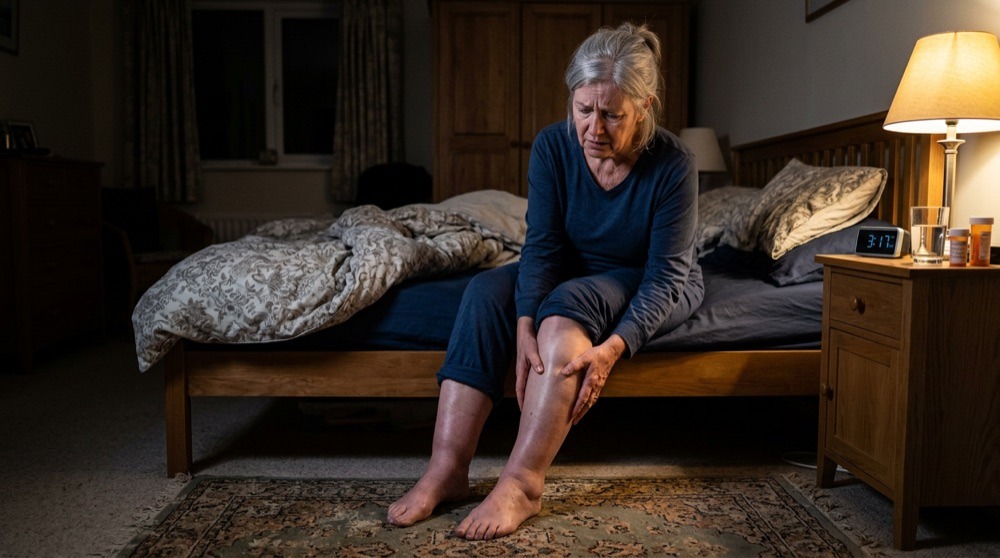
Jane knew the feeling before she opened her eyes.
It had been building for years, and by last summer it had a shape she could set a clock by.
"I was cooking spaghetti for my family. My legs felt so heavy and tight that day I had to sit down twice just to finish dinner."
Her voice softens. "I remember looking down at my ankles that night and not recognising my own feet. My shoes had been fine that morning. By eight o'clock I couldn't get them back on."
What Jane was describing is one of the most common everyday complaints women bring to their doctors after fifty — and one of the least talked about openly.
Fluid settles in the lower legs over a long day. It is measurable: in healthy adults, researchers have tracked fluid steadily collecting in the lower leg over a single extended stretch of sitting.[3]
The tricky part is that it builds quietly.
The swelling is what you notice. It is not what starts it.
Heaviness that builds gradually over a long day and settles overnight is one thing. Some swelling is not, and needs a doctor rather than a supplement. Seek medical attention promptly if swelling comes on suddenly, affects only one leg, comes with pain, warmth, redness, shortness of breath or chest discomfort, keeps getting worse, or appears alongside a known heart, kidney, liver, thyroid or circulatory condition, or during pregnancy.
The plant compound behind the routine
The routine women are talking about is built around a family of plant compounds called flavonoids — the pigments that give red clover, citrus peel and dark berries their colour.
Women who add them to their evening tend to describe the same sequence, in the same order:
- The tight, puffy feeling in the feet and ankles is usually the first thing they say eases.
- Heavy, aching legs at the end of the day tend to be the next thing they mention.
- Shoes and socks that had started to feel tight begin to feel normal again.
- Individual experiences vary. Some women notice very little, and no result is promised or guaranteed.
To understand why anyone would reach for a plant compound for this at all, it helps to look at what is happening in the vessel wall.
The hidden cause of swollen legs
It comes down to something physiologists call capillary permeability — in plain language, “leaky vessels.”
Look at the smallest blood vessels under strong magnification and you do not see a sealed pipe. You see a wall with gaps in it.
Those gaps are supposed to be there. They are how oxygen and nutrients get out to your tissues.
But the balance of what leaves the vessel and what gets carried back is a fine one, and it is well described in the physiology literature.[2] When more fluid crosses the wall than the body carries away, it pools in the surrounding tissue.
Just like a leaky pipe under a floor.
And here’s why it’s such a problem.
Your body has around 60,000 miles of blood vessels, enough to wrap the Earth twice.
Now picture gravity pulling fluid down into your legs while you sit still. Hour after hour.
In fact, the U.S. National Library of Medicine notes that a modest build-up of fluid in the tissues may not be detectable at all — it takes an excess of several liters before the swelling becomes visible and palpable.[1]
Which means by the time you notice it — heavy legs, sock marks, tight shoes — the legs, ankles and feet have been filling for a while.
Why fluid starts to settle
For most women, it’s not a single thing — it’s a few, quietly building over the years. Here are the most common:
Hours held in one position
The most consistent factor in the measurement studies is simply time spent still, seated or standing, with the calf doing no work. The same pattern shows up over the hours of a long flight.[4]
Menopause and hormones
Many women notice their legs and hands change through perimenopause and after. Fluid balance is one of the things most often reported shifting during that stretch of life.
Extra weight
Every extra pound adds pressure inside the leg veins. Over time that constant load means more fluid pushed out into the tissue for the same hours on your feet.
Age
Vessel walls are under pressure every day, for decades. They gradually become less elastic, and the balance of fluid in and fluid out shifts with them.
That’s why the usual advice only goes so far. Elevate your feet, wear compression socks, cut salt — all of it is worth doing, and all of it is standard advice for good reason. In a randomised controlled trial in healthy women, compression stockings measurably raised leg lymph pumping pressure.[5] But it works while you are doing it, and most women find the fullness is back by evening.
Signs fluid is settling
Legs & ankles
- Ankles swell by evening
- Heavy legs by evening
- Sock marks
- Legs feel tight
Face & hands
- Puffy face in the morning
- Puffy eyelids in the morning
- Rings feel tight on your fingers
The Nobel Prize winner who named these compounds

The human body needs vitamins to work.
Your heart needs potassium to beat.
Your brain needs vitamin B to think.
Your skin needs vitamin C to stay firm.
In 1936, two Hungarian researchers thought they had found one more.
Rusznyák and Szent-Györgyi published a short paper in Nature on a group of plant compounds — flavonols — that appeared to act on the permeability of small blood vessels. They called it “vitamin P,” for permeability.[6] Szent-Györgyi won the Nobel Prize the following year for his work on vitamin C.
Here is the part usually left out. The “vitamin P” name was later withdrawn — these compounds turned out not to be vitamins, because the body does not require them from food the way it requires vitamin C, and the term fell out of scientific use around 1950. The compounds themselves did not go anywhere. Flavonoids are still one of the most heavily studied families of plant compounds in the world. They are simply not a vitamin, and nobody can honestly sell them as one.
There was just one problem for anyone wanting to actually take them: the richest sources are not things most people eat.
One of them is ordinary enough that it grows in fields across America — the blossom of red clover.
Red clover blossom is the flavonoid ingredient in this category with the most human research behind it. In a randomised study in menopausal women, red clover isoflavones improved a measure of systemic arterial compliance,[7] and a separate placebo-controlled study in men and postmenopausal women found isoflavones reduced arterial stiffness.[8]
Those are vascular measurements in specific groups of people. They are not evidence that any supplement reduces swelling in your legs or ankles, and they should not be read that way.
How flavonoids are thought to act on the vessel wall
Vessel walls are held firm in part by collagen — the same protein that helps keep your skin tight.
As you age, that collagen changes. Walls become less elastic, and the balance of fluid crossing them shifts.
Flavonoids have been studied for their interaction with connective tissue and with the permeability of small vessels — which is exactly what caught Szent-Györgyi’s attention in the first place.
Enzymes in the body act on collagen continuously, and that turnover is part of how vessel walls change over the years.
Flavonoids’ interaction with those processes is an active area of laboratory research.
What women tell us,
week by week
We asked women who had been using a flavonoid-based evening routine for at least two months what they noticed, and when.
Here’s what came up most often:
- Week 1Extra trips to the bathroom
Some women mention two or three extra bathroom trips in the first days. Others notice nothing at all in the first week.
- Week 2Feet and ankles
Sock marks less deep. Shoes going on more easily in the morning. The evening heaviness described as starting to ease.
- Week 3Face and hands
Puffiness around the eyes in the morning, and rings that had felt tight, are the next things women tend to bring up.
- Week 4Evenings
By the fourth week, the most common comment is about the end of the day — legs that feel lighter at night and less discomfort settling into bed.
- Week 8Not thinking about it
The comment we hear most at two months is not dramatic. It is that they stopped noticing their legs.
“Honestly, my ankles haven’t looked this good in a while. By the end of the day they used to feel so tight. Now they mostly don’t do that. I’m happy with it.”

“My legs feel lighter than they did. I still keep my compression socks for long days, but I reach for them less often than I used to.”

“That heavy, aching feeling I’d get by evening is much less than it was. I can be on my feet all day now and I don’t dread it the way I did.”

Beyond the legs
When the evening heaviness eases, women often say the difference isn’t only in the legs. These are the things they mention most, and they are personal impressions rather than measured outcomes.
- Energy through the daySleeping better and ending the day less uncomfortable tends to leave people feeling more rested.
- Feeling clearerSeveral women describe feeling less foggy, which they put down to sleeping through the night.
- Clothes fitting the way they used toWaistbands and rings are the two things women mention noticing first after their shoes.
- Less puffiness in the morningAround the eyes and in the face is where women say they see it.
- Easier on the stairsLess end-of-day discomfort in the legs is what most connect this to.
Where to get it
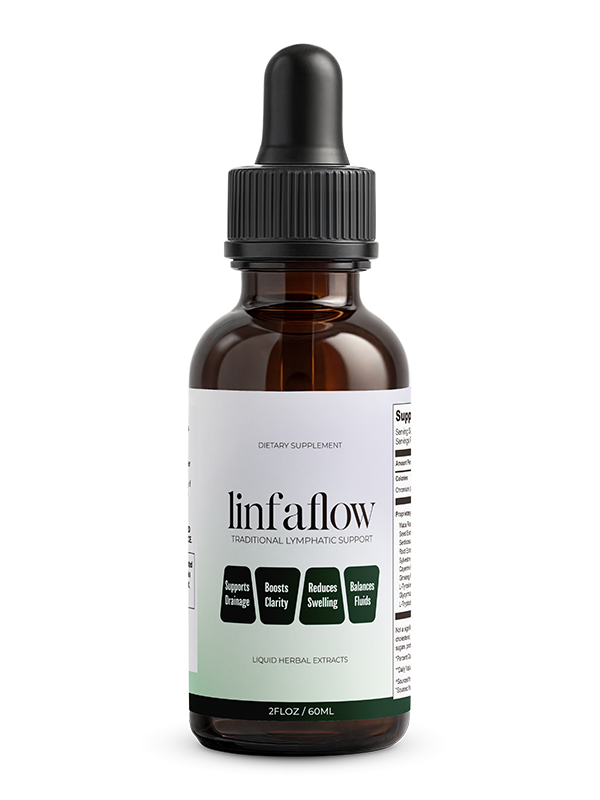
Linfaflow is one of the liquid herbal formulas sold in the United States in this category. It is a dietary supplement — not a medicine, and not a substitute for one.
It is a liquid herbal extract of red clover blossom, cleavers aerial parts, prickly ash bark and stillingia root, taken in a small amount of water. Red clover blossom is the flavonoid-bearing ingredient discussed above. The other three come from traditional Western herbal practice and have very little modern clinical research behind them — traditional use is a reason a plant ends up in a formula, not proof that it works.
Linfaflow is made in the U.S., in a facility registered with the FDA and following Good Manufacturing Practice.
To keep it affordable, Linfaflow is not sold on Amazon, Walmart or in drugstores. It’s available only through the official website. Tap below to see the current price and options.
At a Glance
Linfaflow
Rating reported by the seller from verified purchases on its official website.
GMP-certified
(not FDA approval — see below)
The guarantee
Try Linfaflow for 60 days. If you’re not happy with it, the seller offers a full refund — and you keep the bottles. Refund terms, shipping costs and current pricing are set by the seller and shown on its checkout page; read them there before ordering.
For a refund, or for any question about an order, billing or shipping, contact the seller directly on +1 (800) 390-6035 or support@linfaflow.com. Lymphatic Report does not sell, ship, bill or handle returns for this product.
How to get 70% off
To introduce Linfaflow to more women, the seller is offering readers of this page 70% off its regular price. The discount is applied on the official website, where the full price, the discounted price and the terms are shown before you order.
In their words
What women who use Linfaflow told us
We spoke with several longtime Linfaflow users to hear, in their own words, how it has gone for them. Their experiences varied, and the same themes came up again and again. Here is what three of them shared.
“I’m on my feet all day behind the chair. By closing time my ankles felt so tight my socks left deep rings. Within the first couple of weeks I felt the tightness starting to ease. My shoes slide on more easily in the morning now. I keep telling the girls at the salon about it.”

“I’ll be honest, at first I wasn’t sure I’d feel much. But by the end of the first week my legs already felt lighter at night. Then around week four I stopped propping them up on two pillows just to sleep. If you’re the type to give up early, don’t. Stick with it.”

“My daughter got married in June, and I’d been dreading it for months. I pictured myself sitting the whole time while everyone else danced. I’d been taking the drops since early spring. I stood through the ceremony and I danced at the reception. That day meant everything to me.”

Regulatory status of this product
Linfaflow is sold in the United States as a dietary supplement. Under U.S. law, dietary supplements are not reviewed for safety or effectiveness before they go on sale.
This product has not been evaluated or approved by the U.S. Food and Drug Administration (FDA). The statements on this page have not been evaluated by the FDA. This product is not intended to diagnose, treat, cure or prevent any disease or medical condition, and it is not a substitute for medication, diagnosis, evaluation or treatment prescribed by a physician or other qualified healthcare provider. Consult a doctor before starting any new supplement or routine.
Important safety information
- Intended for adults aged 18 or over.
- Not for use if you are pregnant or nursing.
- Herbal preparations can interact with prescription medicines. If you take any medication — particularly for blood pressure, the heart, blood thinning, hormones or the thyroid — speak to your doctor or pharmacist before use.
- Red clover contains isoflavones with oestrogen-like activity. Anyone with a hormone-sensitive condition, or a personal or family history of one, should seek medical advice before use.
- Do not exceed the dose on the label. Discontinue use and consult a healthcare professional if you experience any adverse reaction.
- Individual experiences vary. No specific result is promised, implied or guaranteed.
Scientific references
Sources for the physiological statements made above, and for the research on the ingredients named. These references describe how fluid behaves in the lower body and what has been measured for red clover isoflavones. They are not evidence that any supplement reduces swelling.
- Edema, in Clinical Methods: The History, Physical, and Laboratory Examinations (3rd edition), U.S. National Library of Medicine, 1990 [Link]
- Understanding and extending the Starling principle, Acta Anaesthesiologica Scandinavica, September 2020 [Link]
- Leg fluid accumulation during prolonged sitting, Annual International Conference of the IEEE Engineering in Medicine and Biology Society, August 2016 [Link]
- Leg edema formation and venous blood flow velocity during a simulated long-haul flight, Thrombosis Research, 2007 [Link]
- Effects of Compression Stockings on Elevation of Leg Lymph Pumping Pressure and Improvement of Quality of Life in Healthy Female Volunteers: A Randomized Controlled Trial, Lymphatic Research and Biology, June 2016 [Link]
- Vitamin P: Flavonols as Vitamins, Nature, July 1936 [Link]
- Isoflavones from red clover improve systemic arterial compliance but not plasma lipids in menopausal women, The Journal of Clinical Endocrinology and Metabolism, March 1999 [Link]
- Isoflavones reduce arterial stiffness: a placebo-controlled study in men and postmenopausal women, Arteriosclerosis, Thrombosis, and Vascular Biology, June 2003 [Link]
Comments
8How long does delivery usually take? My ankles have been so tight again by the evening 😕
Hi Sarah! I'm near Chicago and mine arrived in 3 business days. Super fast!
I bought mine last week at full price and now there's a discount, a bit annoying 😅 Still glad I got it though. My legs don't feel like lead weights by bedtime the way they did.
Does this suit you if you sit at a desk all day? My ankles are always tight by the evening 😕
Lena I'm in sales, on my feet 8 hours a day. Since I started Linfaflow my shoes fit better again at night. Everyone's different though!
Started three weeks ago and my husband asked me "are you doing something different? Your legs look better." Made me happy 😊
How quickly did people notice anything?
Charlotte for me it was the first week — I was in the bathroom more often at the start, and the stiffness in my calves eased off. My sister tried it and said it took her longer.